














Palantir (NASDAQ: PLTR) may be one of the rare AI stocks that does not need the frontier-model arms race to accelerate forever.
AI-linked shares are under pressure on Monday after Anthropic CEO Dario Amodei and other industry leaders backed slowing development of increasingly powerful models over safety concerns.
Yet D.A. Davidson has just raised its Palantir target to $250, implying roughly 50% upside from the share price when the call was made.
The bull case rests on an important distinction that Palantir does not need to build the world’s best model. It needs companies and governments to keep deploying AI.
Palantir stock can still win if the model race slows
A slowdown at OpenAI, Anthropic or other frontier labs would matter enormously for GPU demand and companies whose economics depend on training ever-larger models.
Palantir sits elsewhere in the stack.
D.A. Davidson analyst Gil Luria raised his target to $250 from $200 after AIPCon 11 and maintained a Buy rating.
He argued that customers are becoming more sophisticated about choosing different models for different tasks and increasingly want control over their own data and infrastructure.
Luria sees Palantir potentially becoming a “control plane and orchestration layer” for enterprise AI.
That matters if safety concerns lead to slower frontier development or tighter regulation.
Enterprises may place greater value on knowing where models run, what data they can access and how outputs are governed.
Fragmentation could therefore help Palantir. The company does not need one model provider to dominate if customers require software that can manage several of them.
The bullish case is already visible in the numbers
Palantir’s second-quarter results show that enterprise AI adoption is still accelerating.
Revenue jumped 93% year over year to $1.94 billion, while US commercial revenue surged 149% to $764 million. US commercial total contract value climbed 153% to a record $2.13 billion.
Those numbers suggest customers are moving beyond experiments and into larger deployments.
Rosenblatt analyst John McPeake reiterated a Buy rating and $225 target after AIPCon 11, saying customer checks indicated a “strong pipeline of potential commercial customer conversions across multiple verticals.”
The recent Nvidia partnership strengthens that argument.
Nvidia is deploying a Palantir-based sovereign AI stack across its own supply chain, combining Palantir’s software with Nvidia’s Nemotron models.
The distinction is important, as AI development can slow while enterprise adoption continues expanding.
Valuation remains the uncomfortable part of the story
A slower AI arms race does not solve Palantir’s biggest problem: investors are already paying heavily for exceptional growth.
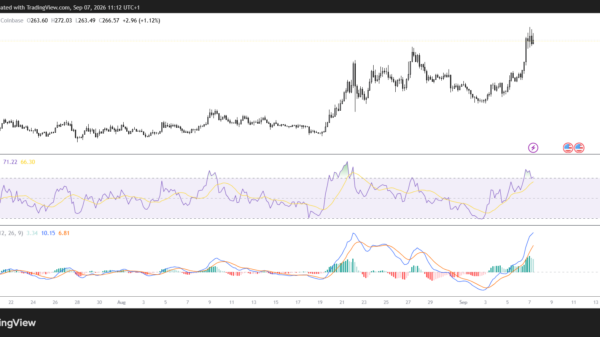
As per market data, the stock is trading at roughly 82 times expected forward earnings, leaving it vulnerable when bond yields rise or growth expectations soften.
Michael Monaghan of Founders ETFs told MarketWatch that Palantir will need to continue “earning” its valuation by outperforming expectations.
That bar is unusually high.
Palantir grew revenue 93% last quarter and raised its full-year growth outlook to roughly 82%. Numbers that would look extraordinary almost anywhere else are becoming the baseline investors expect.
Competition is also increasing, as Alphabet is pushing deeper into government and cybersecurity AI, while other software vendors are building orchestration and governance tools of their own.
The key distinction for investors is between an AI development slowdown and an AI adoption slowdown.
If frontier labs build models more cautiously while enterprises continue deploying existing technology, Palantir could remain unusually well positioned.
The post Palantir stock may win even if AI boom slows: why Wall Street sees 50% upside appeared first on Invezz