














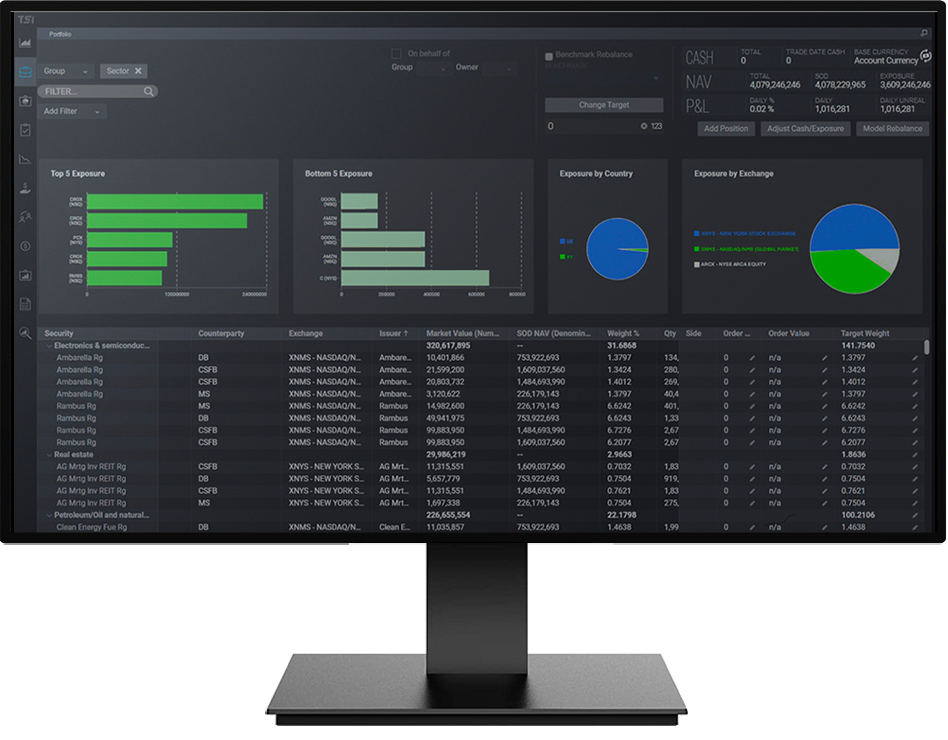
TS Imagine has launched TSIQ, an artificial intelligence platform designed to explain data, recommend actions and run workflows across trading, risk, portfolios, wealth management and prime brokerage. The company says the release follows five years and $100 million of investment in data, infrastructure and financial context.
TSIQ is being added across the vendor’s existing platform rather than sold only as a separate chatbot. Its purpose is to place AI beside execution, risk and portfolio decisions while keeping a person responsible for approvals and control.
The $100 Million Went Into Data Before Agents
TS Imagine began building a consolidated data foundation in 2021. The work combined pricing, reference, analytics, corporate-action and transaction data before the current wave of generative and agentic AI products reached capital markets.
The TSIQ ontology sits above that foundation. It connects instruments, financial concepts, relationships and business rules so an answer can be traced to records and logic. TS Imagine says clients can apply the structure to their own data within a secure environment.
That approach addresses a central problem in institutional AI: a model can produce fluent text without understanding how a security, account, benchmark and risk measure relate to one another. A semantic layer does not eliminate model error, but it can constrain inputs and make an output easier to audit.
Other providers are taking related routes. Bloomberg has compared automated and manual order outcomes, and BGC has moved AI from analysis into an institutional trading workflow. TSIQ is broader in stated scope, but TS Imagine has not published client results for each proposed use.
Explain, Recommend and Act Are Different Risk Levels
An explanation can summarize portfolio stress or order slippage. A recommendation adds a proposed response. An action changes a workflow or record. Each step requires a different permission model, evidence threshold and review process.
TS Imagine says human oversight remains available at every stage. That is important in regulated trading because an auditable source does not automatically make a recommendation suitable. Firms must decide which tasks can run automatically, which require approval and which should remain outside the AI layer.
The distinction also appears in market surveillance. AI surveillance systems can help identify wash-trading patterns, but investigators remain responsible for deciding whether the evidence supports escalation. Trading safeguards become more important when automation can act rather than only summarize.
TSIQ Enters a Market Moving From Answers to Workflows
Financial institutions have spent the first phase of generative AI adoption on search, document retrieval and drafting. Vendors are now competing to connect models with orders, risk records and operational tasks.
That shift is visible across products. Bloomberg now supports a programmatic FX options workflow from request to execution. In digital finance, AI agents have already generated measurable stablecoin payment activity.
Rob Flatley, founder and chief executive officer of TS Imagine, said TSIQ is intended to let institutions redesign workflows and obtain productivity gains. Thomas Bodenski, chief operating officer and chief data and AI officer, said capital-markets AI needs an auditable framework capable of explaining the context behind an output.
TS Imagine describes TSIQ as broadly available, but it has not named initial clients, pricing or measured reductions in processing time. The $100 million figure shows the scale of the build. Adoption will depend on how much of the platform can move from explanation into controlled action without increasing model, conduct or operational risk.