



















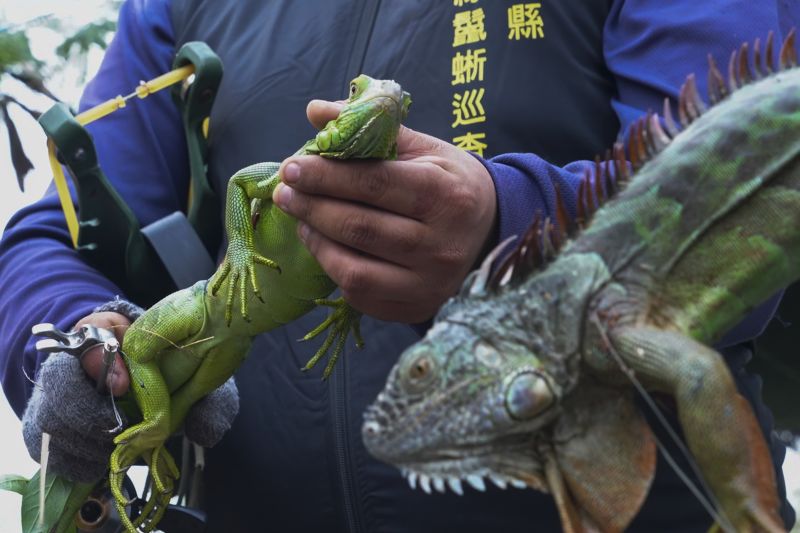
Taiwan plans to cull up to 120,000 green iguanas, with supporters urging humane methods to bring down the animal’s population, which is wreaking havoc on the island’s agricultural sector.
Around 200,000 of the reptiles are believed to be in the island’s southern and central areas, which are heavily dependent on farming, according Chiu Kuo-hao of the Forestry and Nature Conservation Agency.
Specially recruited hunting teams killed about 70,000 iguanas last year, with bounties of up to $15 each. Local governments have asked the public to help identify iguana nests and they recommend fishing spears as the most humane means of killing the animals.
“A lot of people bought them as cute little pets, not realizing how big and long-lived they would become, so they set them free in the wild, where they’ve really taken to the Taiwanese environment,” said Lee Chi-ya of the agricultural department in the southern county of Pingtung. “That’s allowed them to reproduce at a considerable rate, necessitating us to cull them and restore the balance of nature.”
Green iguanas have no natural predators in Taiwan and have moved into areas that can be difficult to access, mostly forests and the edges of towns.
Males can grow to 2 feet (6.6 feet) long, weigh 5 kilograms (11 pounds) and live up to 20 years, while females can lay up to 80 eggs at a time.
Mainly native to Central America and the Caribbean, they are not aggressive despite possessing sharp tails and jaws and razor-like teeth. The reptiles subsist on a diet of mostly fruit, leaves and plants, with the occasional small animal thrown in.
Though popular as pets, they are difficult to keep healthy in captivity and many die within a year.
Hsu Wei-chieh, secretary general of the Reptile Conservation Association of Taiwan, said his group wants to teach farmers how to stay safe, protect their property and treat the iguanas in a humane manner.
“We’re here to help see that this project is carried out smoothly,” said Hsu.
Tsai Po-wen, a vegetable farmer in Pingtung, said the training was paying off.
“We used to attack them, but it wasn’t any use. Now we’re learning more effective, safer methods,” Tsai said.